
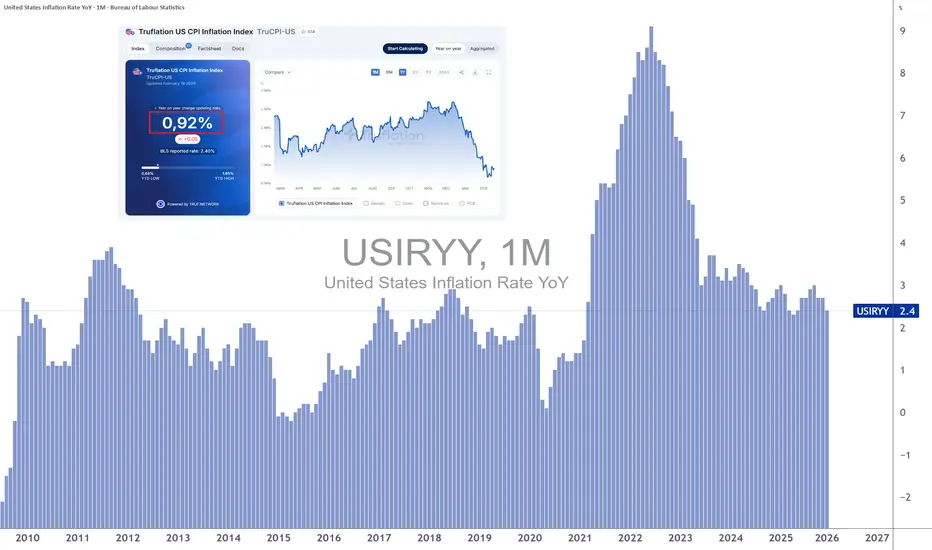
The very latest updates on US inflation according to the CPI price index deliver a clear message: disinflation has resumed in the United States after a plateau phase that lasted several months. However, the inflation target of the Federal Reserve is still not reached and remains at 2%.
The January figures for US inflation according to CPI are not far from the target:
• 2.4% for headline inflation
• 2.5% for core inflation, the lowest level since March 2021
But there is another inflation data point that is even more remarkable. It is the drop observed in real-time inflation measures since the end of last year. According to Truflation, a real-time inflation measurement service increasingly respected by high finance and which uses blockchain technology as a data integrity ledger, real-time inflation — the “true” inflation — has fallen below the 1% threshold.
It is widely accepted that, due to its construction, Truflation leads official inflation as measured by CPI and PCE by several months. Under these conditions, can we envisage that the official CPI will also fall below the 2% threshold during 2026? The answer is probably yes — let’s examine why.

The first explanation lies in the structural lag of the housing component within CPI. Housing represents about one third of the CPI basket, and its key component, owners’ equivalent rent, reacts with a delay of several quarters to turning points in the real housing market. However, private rent data show clear disinflation since the end of 2025, with effective rents stagnating or even slightly declining in many US metropolitan areas. This dynamic is already captured by Truflation, while the official CPI continues to reflect past increases.
Second factor: the full normalization of supply chains and increased competitive pressure in goods markets. Prices of durable goods, electronics, furniture, and many everyday consumer products are now trending lower or rising only very slightly. Once again, Truflation captures these adjustments almost in real time, while CPI, based on monthly surveys and rolling averages, smooths these movements significantly.
Third, domestic demand shows clear signs of moderation. The slowdown in credit, the fatigue of discretionary consumption, and the rise in precautionary savings are exerting disinflationary pressure on services excluding housing. This trend is consistent with the pullback observed on Truflation since the end of 2025.

Historically, during phases of rapid disinflation, the Truflation indicator has led CPI by 6 to 12 months. If this pattern repeats, the official CPI should continue to move gradually toward the 2% area in the first half of 2026, with a non-negligible risk of a temporary dip below this threshold in the second half, particularly if housing disinflation fully materializes in official statistics.
In summary, the current divergence does not signal a “mistake” in CPI, but rather a lag in statistical transmission. Truflation acts as a leading indicator of price dynamics, while CPI remains a slower institutional thermometer. If the real-time trend is confirmed, the probability of CPI flirting with, or even falling below, 2% in 2026 is high, which would allow the Federal Reserve to resume interest rate cuts.
DISCLAIMER:
This content is intended for individuals who are familiar with financial markets and instruments and is for information purposes only. The presented idea (including market commentary, market data and observations) is not a work product of any research department of Swissquote or its affiliates. This material is intended to highlight market action and does not constitute investment, legal or tax advice. If you are a retail investor or lack experience in trading complex financial products, it is advisable to seek professional advice from licensed advisor before making any financial decisions.
This content is not intended to manipulate the market or encourage any specific financial behavior.
Swissquote makes no representation or warranty as to the quality, completeness, accuracy, comprehensiveness or non-infringement of such content. The views expressed are those of the consultant and are provided for educational purposes only. Any information provided relating to a product or market should not be construed as recommending an investment strategy or transaction. Past performance is not a guarantee of future results.
Swissquote and its employees and representatives shall in no event be held liable for any damages or losses arising directly or indirectly from decisions made on the basis of this content.
The use of any third-party brands or trademarks is for information only and does not imply endorsement by Swissquote, or that the trademark owner has authorised Swissquote to promote its products or services.
Swissquote is the marketing brand for the activities of Swissquote Bank Ltd (Switzerland) regulated by FINMA, Swissquote Capital Markets Limited regulated by CySEC (Cyprus), Swissquote Bank Europe SA (Luxembourg) regulated by the CSSF, Swissquote Ltd (UK) regulated by the FCA, Swissquote Financial Services (Malta) Ltd regulated by the Malta Financial Services Authority, Swissquote MEA Ltd. (UAE) regulated by the Dubai Financial Services Authority, Swissquote Pte Ltd (Singapore) regulated by the Monetary Authority of Singapore, Swissquote Asia Limited (Hong Kong) licensed by the Hong Kong Securities and Futures Commission (SFC) and Swissquote South Africa (Pty) Ltd supervised by the FSCA.
Products and services of Swissquote are only intended for those permitted to receive them under local law.
All investments carry a degree of risk. The risk of loss in trading or holding financial instruments can be substantial. The value of financial instruments, including but not limited to stocks, bonds, cryptocurrencies, and other assets, can fluctuate both upwards and downwards. There is a significant risk of financial loss when buying, selling, holding, staking, or investing in these instruments. SQBE makes no recommendations regarding any specific investment, transaction, or the use of any particular investment strategy.
CFDs are complex instruments and come with a high risk of losing money rapidly due to leverage. The vast majority of retail client accounts suffer capital losses when trading in CFDs. You should consider whether you understand how CFDs work and whether you can afford to take the high risk of losing your money.
Digital Assets are unregulated in most countries and consumer protection rules may not apply. As highly volatile speculative investments, Digital Assets are not suitable for investors without a high-risk tolerance. Make sure you understand each Digital Asset before you trade.
Cryptocurrencies are not considered legal tender in some jurisdictions and are subject to regulatory uncertainties.
The use of Internet-based systems can involve high risks, including, but not limited to, fraud, cyber-attacks, network and communication failures, as well as identity theft and phishing attacks related to crypto-assets.
The January figures for US inflation according to CPI are not far from the target:
• 2.4% for headline inflation
• 2.5% for core inflation, the lowest level since March 2021
But there is another inflation data point that is even more remarkable. It is the drop observed in real-time inflation measures since the end of last year. According to Truflation, a real-time inflation measurement service increasingly respected by high finance and which uses blockchain technology as a data integrity ledger, real-time inflation — the “true” inflation — has fallen below the 1% threshold.
It is widely accepted that, due to its construction, Truflation leads official inflation as measured by CPI and PCE by several months. Under these conditions, can we envisage that the official CPI will also fall below the 2% threshold during 2026? The answer is probably yes — let’s examine why.
The first explanation lies in the structural lag of the housing component within CPI. Housing represents about one third of the CPI basket, and its key component, owners’ equivalent rent, reacts with a delay of several quarters to turning points in the real housing market. However, private rent data show clear disinflation since the end of 2025, with effective rents stagnating or even slightly declining in many US metropolitan areas. This dynamic is already captured by Truflation, while the official CPI continues to reflect past increases.
Second factor: the full normalization of supply chains and increased competitive pressure in goods markets. Prices of durable goods, electronics, furniture, and many everyday consumer products are now trending lower or rising only very slightly. Once again, Truflation captures these adjustments almost in real time, while CPI, based on monthly surveys and rolling averages, smooths these movements significantly.
Third, domestic demand shows clear signs of moderation. The slowdown in credit, the fatigue of discretionary consumption, and the rise in precautionary savings are exerting disinflationary pressure on services excluding housing. This trend is consistent with the pullback observed on Truflation since the end of 2025.
Historically, during phases of rapid disinflation, the Truflation indicator has led CPI by 6 to 12 months. If this pattern repeats, the official CPI should continue to move gradually toward the 2% area in the first half of 2026, with a non-negligible risk of a temporary dip below this threshold in the second half, particularly if housing disinflation fully materializes in official statistics.
In summary, the current divergence does not signal a “mistake” in CPI, but rather a lag in statistical transmission. Truflation acts as a leading indicator of price dynamics, while CPI remains a slower institutional thermometer. If the real-time trend is confirmed, the probability of CPI flirting with, or even falling below, 2% in 2026 is high, which would allow the Federal Reserve to resume interest rate cuts.
DISCLAIMER:
This content is intended for individuals who are familiar with financial markets and instruments and is for information purposes only. The presented idea (including market commentary, market data and observations) is not a work product of any research department of Swissquote or its affiliates. This material is intended to highlight market action and does not constitute investment, legal or tax advice. If you are a retail investor or lack experience in trading complex financial products, it is advisable to seek professional advice from licensed advisor before making any financial decisions.
This content is not intended to manipulate the market or encourage any specific financial behavior.
Swissquote makes no representation or warranty as to the quality, completeness, accuracy, comprehensiveness or non-infringement of such content. The views expressed are those of the consultant and are provided for educational purposes only. Any information provided relating to a product or market should not be construed as recommending an investment strategy or transaction. Past performance is not a guarantee of future results.
Swissquote and its employees and representatives shall in no event be held liable for any damages or losses arising directly or indirectly from decisions made on the basis of this content.
The use of any third-party brands or trademarks is for information only and does not imply endorsement by Swissquote, or that the trademark owner has authorised Swissquote to promote its products or services.
Swissquote is the marketing brand for the activities of Swissquote Bank Ltd (Switzerland) regulated by FINMA, Swissquote Capital Markets Limited regulated by CySEC (Cyprus), Swissquote Bank Europe SA (Luxembourg) regulated by the CSSF, Swissquote Ltd (UK) regulated by the FCA, Swissquote Financial Services (Malta) Ltd regulated by the Malta Financial Services Authority, Swissquote MEA Ltd. (UAE) regulated by the Dubai Financial Services Authority, Swissquote Pte Ltd (Singapore) regulated by the Monetary Authority of Singapore, Swissquote Asia Limited (Hong Kong) licensed by the Hong Kong Securities and Futures Commission (SFC) and Swissquote South Africa (Pty) Ltd supervised by the FSCA.
Products and services of Swissquote are only intended for those permitted to receive them under local law.
All investments carry a degree of risk. The risk of loss in trading or holding financial instruments can be substantial. The value of financial instruments, including but not limited to stocks, bonds, cryptocurrencies, and other assets, can fluctuate both upwards and downwards. There is a significant risk of financial loss when buying, selling, holding, staking, or investing in these instruments. SQBE makes no recommendations regarding any specific investment, transaction, or the use of any particular investment strategy.
CFDs are complex instruments and come with a high risk of losing money rapidly due to leverage. The vast majority of retail client accounts suffer capital losses when trading in CFDs. You should consider whether you understand how CFDs work and whether you can afford to take the high risk of losing your money.
Digital Assets are unregulated in most countries and consumer protection rules may not apply. As highly volatile speculative investments, Digital Assets are not suitable for investors without a high-risk tolerance. Make sure you understand each Digital Asset before you trade.
Cryptocurrencies are not considered legal tender in some jurisdictions and are subject to regulatory uncertainties.
The use of Internet-based systems can involve high risks, including, but not limited to, fraud, cyber-attacks, network and communication failures, as well as identity theft and phishing attacks related to crypto-assets.

This content is written by Vincent Ganne for Swissquote.
This content is intended for individuals who are familiar with financial markets and instruments and is for information purposes only and does not constitute investment, legal or tax advice.
This content is intended for individuals who are familiar with financial markets and instruments and is for information purposes only and does not constitute investment, legal or tax advice.
Disclaimer
The information and publications are not meant to be, and do not constitute, financial, investment, trading, or other types of advice or recommendations supplied or endorsed by TradingView. Read more in the Terms of Use.
This content is written by Vincent Ganne for Swissquote.
This content is intended for individuals who are familiar with financial markets and instruments and is for information purposes only and does not constitute investment, legal or tax advice.
This content is intended for individuals who are familiar with financial markets and instruments and is for information purposes only and does not constitute investment, legal or tax advice.
Disclaimer
The information and publications are not meant to be, and do not constitute, financial, investment, trading, or other types of advice or recommendations supplied or endorsed by TradingView. Read more in the Terms of Use.