Education
The Difference Between Momentum and Exhaustion
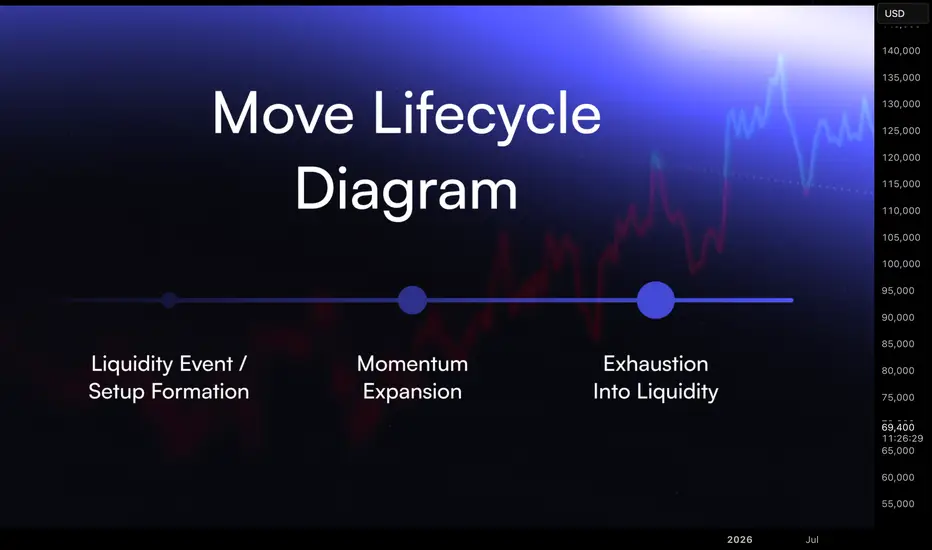
Strong price movement often attracts traders into the market. Large candles, rapid expansion, and rising volume create the impression that the move will continue. In some cases this is correct. In others, the same behavior marks the final stage of the move.
Understanding the difference between momentum and exhaustion is critical for interpreting price action correctly.
Momentum represents sustained participation. When momentum is genuine, price moves with efficiency. Candles progress in the same direction with limited overlap, pullbacks remain shallow, and new highs or lows continue to form. Each impulse move is supported by follow-through rather than immediate reversal.
This type of movement often occurs after a structural event such as a liquidity sweep or a break of structure. Once liquidity has been taken and the market accepts new prices, participation increases and expansion follows.

Exhaustion appears similar on the surface but behaves differently underneath.
Exhaustion often occurs late in a move, usually when price approaches a major liquidity pool or a higher-timeframe level. Instead of clean continuation, the move becomes extended and unstable. Candles grow larger, wicks appear more frequently, and follow-through begins to weaken.
What looks like strength is often the market pushing into the final pocket of liquidity.
When price reaches these areas, several things can happen. Breakout traders enter aggressively, stops are triggered, and late participants rush to join the move. This surge of activity creates a sharp extension that can resemble strong momentum.
However, once that liquidity has been filled, there may be little reason for price to continue further. Without new participation, the move often stalls or reverses.
The key difference lies in behavior after the expansion.
Momentum shows continuation.
Exhaustion shows hesitation.
If price holds above a level and continues building structure, momentum remains intact. If price immediately rejects the level and returns inside the previous range, the move was likely exhaustion.
This is why experienced traders do not evaluate candles in isolation. They evaluate location and sequence.
A large candle in the middle of a range means very little.
The same candle after a liquidity sweep may signal genuine expansion.
The same candle into a major high may signal exhaustion.
Price movement alone does not define the opportunity.
The context surrounding that movement determines its meaning.
When traders learn to distinguish between momentum and exhaustion, they stop chasing late moves and start positioning earlier in the sequence where risk and reward remain balanced.
Understanding the difference between momentum and exhaustion is critical for interpreting price action correctly.
Momentum represents sustained participation. When momentum is genuine, price moves with efficiency. Candles progress in the same direction with limited overlap, pullbacks remain shallow, and new highs or lows continue to form. Each impulse move is supported by follow-through rather than immediate reversal.
This type of movement often occurs after a structural event such as a liquidity sweep or a break of structure. Once liquidity has been taken and the market accepts new prices, participation increases and expansion follows.
Exhaustion appears similar on the surface but behaves differently underneath.
Exhaustion often occurs late in a move, usually when price approaches a major liquidity pool or a higher-timeframe level. Instead of clean continuation, the move becomes extended and unstable. Candles grow larger, wicks appear more frequently, and follow-through begins to weaken.
What looks like strength is often the market pushing into the final pocket of liquidity.
When price reaches these areas, several things can happen. Breakout traders enter aggressively, stops are triggered, and late participants rush to join the move. This surge of activity creates a sharp extension that can resemble strong momentum.
However, once that liquidity has been filled, there may be little reason for price to continue further. Without new participation, the move often stalls or reverses.
The key difference lies in behavior after the expansion.
Momentum shows continuation.
Exhaustion shows hesitation.
If price holds above a level and continues building structure, momentum remains intact. If price immediately rejects the level and returns inside the previous range, the move was likely exhaustion.
This is why experienced traders do not evaluate candles in isolation. They evaluate location and sequence.
A large candle in the middle of a range means very little.
The same candle after a liquidity sweep may signal genuine expansion.
The same candle into a major high may signal exhaustion.
Price movement alone does not define the opportunity.
The context surrounding that movement determines its meaning.
When traders learn to distinguish between momentum and exhaustion, they stop chasing late moves and start positioning earlier in the sequence where risk and reward remain balanced.

Related publications
Disclaimer
The information and publications are not meant to be, and do not constitute, financial, investment, trading, or other types of advice or recommendations supplied or endorsed by TradingView. Read more in the Terms of Use.
Related publications
Disclaimer
The information and publications are not meant to be, and do not constitute, financial, investment, trading, or other types of advice or recommendations supplied or endorsed by TradingView. Read more in the Terms of Use.