Education
Why Your Plan Collapses the Moment Money Becomes Real
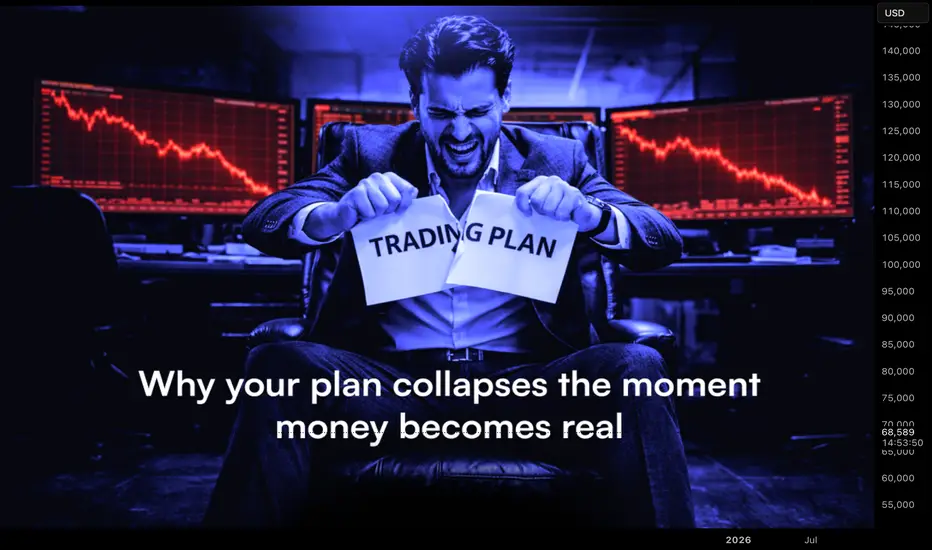
Most trading plans work perfectly in theory.
They fail the moment capital is at risk.
The issue is the shift in perception that happens when simulated outcomes become real financial consequences.
A plan built in a neutral state is tested in an emotional one.
The Hidden Gap Between Planning and Execution
When traders design a strategy, they operate without pressure.
There is no fear of loss. No urgency to act. Decisions are clean and logical.
Once money is involved, the environment changes:
Losses feel personal
Profits trigger premature exits
Patience turns into urgency
The same plan now competes with emotion.
Execution breaks down not because the plan is flawed, but because the trader is no longer following it.
Why Discipline Fails Under Pressure
Most plans define entries and exits.
Few prepare for psychological interference.
Common breakdowns include:
Moving stops to avoid loss
Closing early to secure small profits
Entering late due to fear of missing out
Skipping valid setups after a loss
These actions are not random. They are responses to discomfort.
When money becomes real, avoiding emotional pain becomes the priority, not following the system.
The Real Problem: Lack of Pre-Commitment
A plan without commitment is just a suggestion.
Before entering a trade, three elements must already be accepted:
The risk
The invalidation
The outcome uncertainty
If these are not fully accepted, the trader will interfere once the trade is live.
Execution requires alignment between logic and behavior.
From Strategy to Process
Consistent traders shift focus from outcomes to process.
They do not measure success by whether a trade wins.
They measure it by whether the plan was followed.
This changes decision-making:
Losses become part of execution
Wins are not rushed
Behavior stays consistent across trades
The plan stops being theoretical and becomes operational.
Practical Adjustment
To prevent collapse under real conditions:
Define risk in a way that feels insignificant to your account
Reduce position size until execution becomes stable
Focus on repeatability, not profit
If you cannot follow your plan with real money, the size is too large.
Closing Perspective
The market does not change when money becomes real.
You do.
A trading plan only works if it survives execution.
The goal is not to build a perfect strategy.
It is to build one you can actually follow under pressure.
They fail the moment capital is at risk.
The issue is the shift in perception that happens when simulated outcomes become real financial consequences.
A plan built in a neutral state is tested in an emotional one.
The Hidden Gap Between Planning and Execution
When traders design a strategy, they operate without pressure.
There is no fear of loss. No urgency to act. Decisions are clean and logical.
Once money is involved, the environment changes:
Losses feel personal
Profits trigger premature exits
Patience turns into urgency
The same plan now competes with emotion.
Execution breaks down not because the plan is flawed, but because the trader is no longer following it.
Why Discipline Fails Under Pressure
Most plans define entries and exits.
Few prepare for psychological interference.
Common breakdowns include:
Moving stops to avoid loss
Closing early to secure small profits
Entering late due to fear of missing out
Skipping valid setups after a loss
These actions are not random. They are responses to discomfort.
When money becomes real, avoiding emotional pain becomes the priority, not following the system.
The Real Problem: Lack of Pre-Commitment
A plan without commitment is just a suggestion.
Before entering a trade, three elements must already be accepted:
The risk
The invalidation
The outcome uncertainty
If these are not fully accepted, the trader will interfere once the trade is live.
Execution requires alignment between logic and behavior.
From Strategy to Process
Consistent traders shift focus from outcomes to process.
They do not measure success by whether a trade wins.
They measure it by whether the plan was followed.
This changes decision-making:
Losses become part of execution
Wins are not rushed
Behavior stays consistent across trades
The plan stops being theoretical and becomes operational.
Practical Adjustment
To prevent collapse under real conditions:
Define risk in a way that feels insignificant to your account
Reduce position size until execution becomes stable
Focus on repeatability, not profit
If you cannot follow your plan with real money, the size is too large.
Closing Perspective
The market does not change when money becomes real.
You do.
A trading plan only works if it survives execution.
The goal is not to build a perfect strategy.
It is to build one you can actually follow under pressure.

Related publications
Disclaimer
The information and publications are not meant to be, and do not constitute, financial, investment, trading, or other types of advice or recommendations supplied or endorsed by TradingView. Read more in the Terms of Use.
Related publications
Disclaimer
The information and publications are not meant to be, and do not constitute, financial, investment, trading, or other types of advice or recommendations supplied or endorsed by TradingView. Read more in the Terms of Use.