
Last week in the news
Macro risks are evidently rising with continuation of the Middle East conflict and rising prices of oil. Markets continue to react to such unpredictable macro environments, putting pressure on equities, Treasuries and even gold. The S&P 500 continued its fifth corrective week, closing Friday at 6.368. Despite a modest recovery on Friday, gold continues to be pressured, with a weekly close at $4.493. The strongest reaction last week was with 10Y Treasury yields, which are testing levels modestly below 4,5%. The crypto market is also feeling investors' reluctance, when BTC did not manage to sustain the $70K level, and closed the week at $67K.
Although last week lacked major macroeconomic data, fundamentals continued to influence investor sentiment, particularly elevated oil prices. Key releases for the week included the S&P Global Manufacturing PMI flash for March, which came in at 52.4, slightly above the estimate of 51.3. The University of Michigan Consumer Sentiment for March was finalized at 53.3, with five-year inflation expectations steady at 3.2%.
Rising oil prices continued to pressure markets as escalating tensions around the Strait of Hormuz threatened global supply, pushing Brent and WTI back toward $100+ a barrel amid doubts over a ceasefire. This surge in energy costs is stoking inflation concerns worldwide, with higher fuel and transportation prices expected to feed through broader price indexes. As a result, central banks face increased pressure on monetary policy, with investors and policymakers wary that persistent energy driven inflation could delay rate cuts or even prompt further tightening. As per CME FedWatch tool, markets are currently pricing in a high probability of the Federal Reserve holding rates steady at its next meeting.
U.S. technology stocks came under heavy pressure this week amid escalating geopolitical tensions and broader market weakness, with major names leading declines. Meta Platforms shares slid sharply after adverse legal rulings held the company and others accountable for harms tied to their platforms, eroding investor confidence and dragging on the tech heavy indices. Market anxieties over inflation, rising yields, and slower growth in AI spending also weighed on other big tech giants, contributing to major US equity indexes' entry into correction territory and broader sell-offs across Microsoft, Alphabet, and Nvidia. The combination of legal risks and macroeconomic concerns has intensified volatility in the sector, amplifying downside pressure on major technology stocks.
As per news reporting, U.S. mortgage giant Fannie Mae will for the first time support mortgage loans that leverage cryptocurrency holdings, allowing homebuyers to use assets like Bitcoin or USDC as collateral for their down payment rather than selling them outright. The product, launched in partnership with Better Home & Finance and Coinbase, integrates crypto into traditional conforming mortgages, potentially expanding access to homeownership for digital asset holders while helping borrowers avoid taxable events tied to selling crypto. Although initially likely to remain a niche offering, this move marks a significant step toward mainstream acceptance of digital assets within the U.S. housing finance system and could influence how lenders and investors view crypto as part of broader credit markets.
CRYPTO MARKET
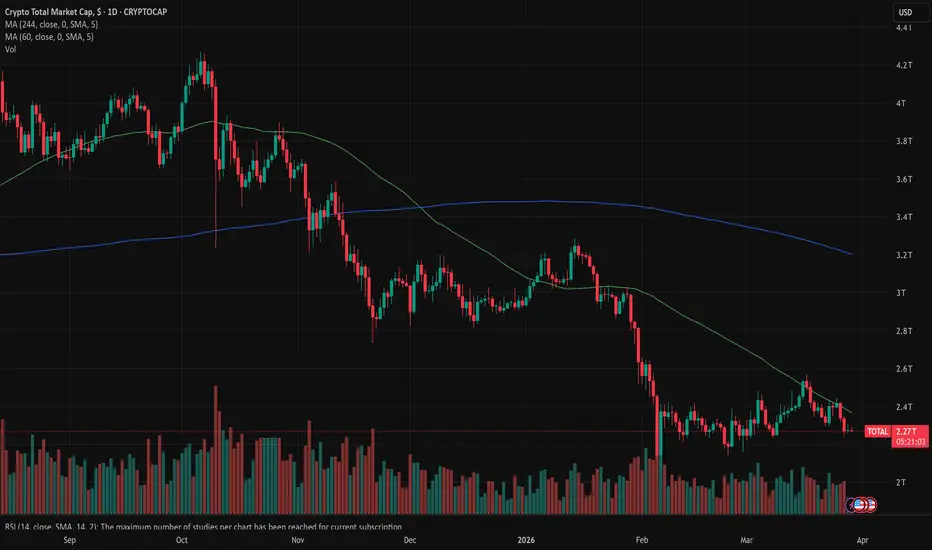
Rising macro risks are in the focus of investors both on traditional and crypto markets. Surging oil prices are making inflation pressures, which makes the current macro outlook unstable and especially future moves of central bankers. Considering the high level of uncertainties, investors are reluctant to invest their capital in any market. The crypto market modestly corrected as of the end of the previous week. Total market capitalization decreased by 4,3% w/w with an outflow of $104B. Daily trading volumes were just modestly increased to the level of $134B on a daily basis, from $125B traded a week before. Total market capitalization since the beginning of this year currently stands in a negative territory of -22%, with a total outflow of -$650B.
BTC and ETH once again set the tone for the market. Bitcoin declined by 5.0% on a weekly basis, while Ethereum posted a somewhat steeper 5.8% w/w loss, reflecting renewed pressure on the largest and most liquid crypto assets. XRP also moved lower, falling 6.1%, while BNB declined 3.9% during the same period. The weakness was broad, with Solana down 6.8%, Avalanche lower by 6.0%, and Cardano declining 5.0%.
Among the largest negative weekly movers among altcoins, Polkadot recorded the sharpest decline, falling 13.8% w/w. Filecoin also posted a significant drop of 12.9%, while DOGE declined 10.3%. Additional notable losses were seen in IOTA (-8.6%), SUI (-7.6%), and Theta (-7.1%), highlighting broad weakness across the altcoin space.
On the positive side, only a limited number of assets managed to finish the week in green. ONDO stood out with a solid 7.0% weekly gain, Stellar also advanced 3.7%, while Tron moved 1.6% higher, providing only selective pockets of strength in an otherwise negative market environment.
Outside of the main monitored list, several tokens delivered exceptional upside performance despite the broader market sell-off. Siren led the gains with a sharp 77.6% weekly surge, followed by MemeCore with a 35.0% increase, while Midnight advanced by 19.0% w/w, placing them among the top performers across the broader crypto universe.
Circulating supply changes remained relatively modest this week. Tether, DOGE, Stellar, DASH, Zcash, Solana and Filecoin each recorded a 0.1% increase in circulating supply, while Hyperliquid remained the only asset with a slight 0.2% decrease.
CRYPTO FUTURES MARKET
Bitcoin futures recorded a broad-based decline this week, reversing the previous period’s moderate consolidation with a renewed downside move across the curve. The March 2026 maturity fell by 5.68% w/w, settling at $66,235. Across the rest of the term structure, losses were remarkably consistent, ranging between 5.92% and 6.12%, with the August 2026 maturity posting the steepest weekly drop. The December 2027 maturity closed at $72,430, down 5.99% on the week. The parallel nature of the move indicates another uniform downward repricing rather than stress concentrated in any specific maturity.
Ether futures also moved decisively lower, underperforming Bitcoin slightly as weekly losses ranged from 6.56% to 6.99%. The March 2026 maturity settled at $1,993, down 6.56%, while the August 2026 maturity recorded the largest decline at 6.99%. Longer dated futures remained under similar pressure, with the December 2027 maturity closing at $2,203, representing a weekly loss of 6.69%.
It is also worth noting that September 2027 futures appeared on the curve for the first time this week for both Bitcoin and Ether, with initial pricing at $71,560 and $2,175, respectively.
Despite the sharp correction, both Bitcoin and Ether futures curves continue to maintain their contango structure, with longer dated maturities trading at progressively higher price levels than near term futures. This suggests that while short term sentiment weakened materially during the week, longer term forward pricing still reflects expectations of relatively higher valuations over time.
Macro risks are evidently rising with continuation of the Middle East conflict and rising prices of oil. Markets continue to react to such unpredictable macro environments, putting pressure on equities, Treasuries and even gold. The S&P 500 continued its fifth corrective week, closing Friday at 6.368. Despite a modest recovery on Friday, gold continues to be pressured, with a weekly close at $4.493. The strongest reaction last week was with 10Y Treasury yields, which are testing levels modestly below 4,5%. The crypto market is also feeling investors' reluctance, when BTC did not manage to sustain the $70K level, and closed the week at $67K.
Although last week lacked major macroeconomic data, fundamentals continued to influence investor sentiment, particularly elevated oil prices. Key releases for the week included the S&P Global Manufacturing PMI flash for March, which came in at 52.4, slightly above the estimate of 51.3. The University of Michigan Consumer Sentiment for March was finalized at 53.3, with five-year inflation expectations steady at 3.2%.
Rising oil prices continued to pressure markets as escalating tensions around the Strait of Hormuz threatened global supply, pushing Brent and WTI back toward $100+ a barrel amid doubts over a ceasefire. This surge in energy costs is stoking inflation concerns worldwide, with higher fuel and transportation prices expected to feed through broader price indexes. As a result, central banks face increased pressure on monetary policy, with investors and policymakers wary that persistent energy driven inflation could delay rate cuts or even prompt further tightening. As per CME FedWatch tool, markets are currently pricing in a high probability of the Federal Reserve holding rates steady at its next meeting.
U.S. technology stocks came under heavy pressure this week amid escalating geopolitical tensions and broader market weakness, with major names leading declines. Meta Platforms shares slid sharply after adverse legal rulings held the company and others accountable for harms tied to their platforms, eroding investor confidence and dragging on the tech heavy indices. Market anxieties over inflation, rising yields, and slower growth in AI spending also weighed on other big tech giants, contributing to major US equity indexes' entry into correction territory and broader sell-offs across Microsoft, Alphabet, and Nvidia. The combination of legal risks and macroeconomic concerns has intensified volatility in the sector, amplifying downside pressure on major technology stocks.
As per news reporting, U.S. mortgage giant Fannie Mae will for the first time support mortgage loans that leverage cryptocurrency holdings, allowing homebuyers to use assets like Bitcoin or USDC as collateral for their down payment rather than selling them outright. The product, launched in partnership with Better Home & Finance and Coinbase, integrates crypto into traditional conforming mortgages, potentially expanding access to homeownership for digital asset holders while helping borrowers avoid taxable events tied to selling crypto. Although initially likely to remain a niche offering, this move marks a significant step toward mainstream acceptance of digital assets within the U.S. housing finance system and could influence how lenders and investors view crypto as part of broader credit markets.
CRYPTO MARKET
Rising macro risks are in the focus of investors both on traditional and crypto markets. Surging oil prices are making inflation pressures, which makes the current macro outlook unstable and especially future moves of central bankers. Considering the high level of uncertainties, investors are reluctant to invest their capital in any market. The crypto market modestly corrected as of the end of the previous week. Total market capitalization decreased by 4,3% w/w with an outflow of $104B. Daily trading volumes were just modestly increased to the level of $134B on a daily basis, from $125B traded a week before. Total market capitalization since the beginning of this year currently stands in a negative territory of -22%, with a total outflow of -$650B.
BTC and ETH once again set the tone for the market. Bitcoin declined by 5.0% on a weekly basis, while Ethereum posted a somewhat steeper 5.8% w/w loss, reflecting renewed pressure on the largest and most liquid crypto assets. XRP also moved lower, falling 6.1%, while BNB declined 3.9% during the same period. The weakness was broad, with Solana down 6.8%, Avalanche lower by 6.0%, and Cardano declining 5.0%.
Among the largest negative weekly movers among altcoins, Polkadot recorded the sharpest decline, falling 13.8% w/w. Filecoin also posted a significant drop of 12.9%, while DOGE declined 10.3%. Additional notable losses were seen in IOTA (-8.6%), SUI (-7.6%), and Theta (-7.1%), highlighting broad weakness across the altcoin space.
On the positive side, only a limited number of assets managed to finish the week in green. ONDO stood out with a solid 7.0% weekly gain, Stellar also advanced 3.7%, while Tron moved 1.6% higher, providing only selective pockets of strength in an otherwise negative market environment.
Outside of the main monitored list, several tokens delivered exceptional upside performance despite the broader market sell-off. Siren led the gains with a sharp 77.6% weekly surge, followed by MemeCore with a 35.0% increase, while Midnight advanced by 19.0% w/w, placing them among the top performers across the broader crypto universe.
Circulating supply changes remained relatively modest this week. Tether, DOGE, Stellar, DASH, Zcash, Solana and Filecoin each recorded a 0.1% increase in circulating supply, while Hyperliquid remained the only asset with a slight 0.2% decrease.
CRYPTO FUTURES MARKET
Bitcoin futures recorded a broad-based decline this week, reversing the previous period’s moderate consolidation with a renewed downside move across the curve. The March 2026 maturity fell by 5.68% w/w, settling at $66,235. Across the rest of the term structure, losses were remarkably consistent, ranging between 5.92% and 6.12%, with the August 2026 maturity posting the steepest weekly drop. The December 2027 maturity closed at $72,430, down 5.99% on the week. The parallel nature of the move indicates another uniform downward repricing rather than stress concentrated in any specific maturity.
Ether futures also moved decisively lower, underperforming Bitcoin slightly as weekly losses ranged from 6.56% to 6.99%. The March 2026 maturity settled at $1,993, down 6.56%, while the August 2026 maturity recorded the largest decline at 6.99%. Longer dated futures remained under similar pressure, with the December 2027 maturity closing at $2,203, representing a weekly loss of 6.69%.
It is also worth noting that September 2027 futures appeared on the curve for the first time this week for both Bitcoin and Ether, with initial pricing at $71,560 and $2,175, respectively.
Despite the sharp correction, both Bitcoin and Ether futures curves continue to maintain their contango structure, with longer dated maturities trading at progressively higher price levels than near term futures. This suggests that while short term sentiment weakened materially during the week, longer term forward pricing still reflects expectations of relatively higher valuations over time.

Related publications
Disclaimer
The information and publications are not meant to be, and do not constitute, financial, investment, trading, or other types of advice or recommendations supplied or endorsed by TradingView. Read more in the Terms of Use.
Related publications
Disclaimer
The information and publications are not meant to be, and do not constitute, financial, investment, trading, or other types of advice or recommendations supplied or endorsed by TradingView. Read more in the Terms of Use.