
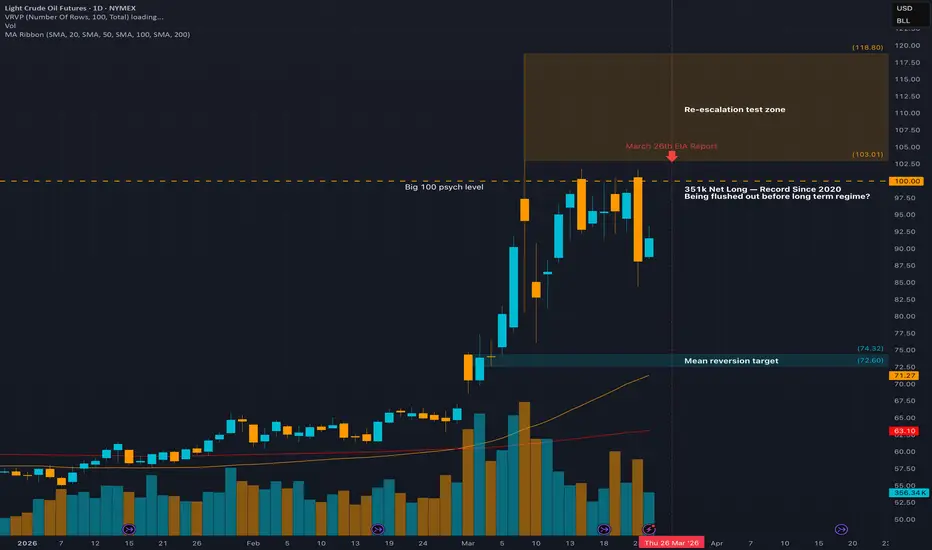
Sunday's analysis made the bearish case for crude at $98.23 — record speculative crowding, producer hedging at $100+, and structural oversupply once Hormuz normalises. The confluence was strong across four of five disciplines. But the word "normalises" is doing heavy lifting in that thesis — so here is the bull case that challenges it.
The Case Against
The Iran conflict has now entered week four of active Strait of Hormuz disruption — significantly longer than the typical 7-14 day Middle East risk premium fade pattern that the bearish thesis relies on. Iraq has declared force majeure, Kuwait refineries have been attacked, and the theatre appears to be expanding rather than contracting. The IEA has confirmed 8 mb/d curtailed — the largest supply disruption in oil market history. The U.S. policy response of releasing sanctioned Iranian cargoes and SPR volumes may prove insufficient if the disruption extends beyond Q2. Qatar's $150/bbl scenario and Goldman's own revised forecast acknowledging longer disruption expectations suggest the tail risk is not trivial. Most critically, the bearish thesis assumes geopolitical premium fade within 3-4 weeks — but this conflict shows no signs of de-escalation, and the historical precedent for this scale of Hormuz disruption simply does not exist.
The Trigger to Watch
The critical level is $100 on a weekly close basis. A sustained break above psychological resistance would signal the market is repricing for extended disruption rather than normalisation, opening a retest of the $110-120 March spike zone. Watch for any headlines indicating expanded military operations, additional force majeure declarations, or failure of U.S. SPR releases to offset curtailed Hormuz flows.
Net Assessment
The primary bearish thesis remains stronger than the contrarian case. The weight of structural evidence — IEA demand downgrades, OPEC+ production increases, and extreme speculative crowding — favours mean reversion once the disruption fades. The contrarian risk is real but relies on a specific geopolitical outcome (sustained escalation) overriding fundamental market dynamics. The thesis holds unless $100 breaks on a weekly closing basis.
The Case Against
The Iran conflict has now entered week four of active Strait of Hormuz disruption — significantly longer than the typical 7-14 day Middle East risk premium fade pattern that the bearish thesis relies on. Iraq has declared force majeure, Kuwait refineries have been attacked, and the theatre appears to be expanding rather than contracting. The IEA has confirmed 8 mb/d curtailed — the largest supply disruption in oil market history. The U.S. policy response of releasing sanctioned Iranian cargoes and SPR volumes may prove insufficient if the disruption extends beyond Q2. Qatar's $150/bbl scenario and Goldman's own revised forecast acknowledging longer disruption expectations suggest the tail risk is not trivial. Most critically, the bearish thesis assumes geopolitical premium fade within 3-4 weeks — but this conflict shows no signs of de-escalation, and the historical precedent for this scale of Hormuz disruption simply does not exist.
The Trigger to Watch
The critical level is $100 on a weekly close basis. A sustained break above psychological resistance would signal the market is repricing for extended disruption rather than normalisation, opening a retest of the $110-120 March spike zone. Watch for any headlines indicating expanded military operations, additional force majeure declarations, or failure of U.S. SPR releases to offset curtailed Hormuz flows.
Net Assessment
The primary bearish thesis remains stronger than the contrarian case. The weight of structural evidence — IEA demand downgrades, OPEC+ production increases, and extreme speculative crowding — favours mean reversion once the disruption fades. The contrarian risk is real but relies on a specific geopolitical outcome (sustained escalation) overriding fundamental market dynamics. The thesis holds unless $100 breaks on a weekly closing basis.

The Macro Edge For Clarity & Confidence
Institutional-grade AI-powered macro analysis every week
macroagentdesk.com
Chat with our agents on Telegram: t.me/macroagentdesk
Institutional-grade AI-powered macro analysis every week
macroagentdesk.com
Chat with our agents on Telegram: t.me/macroagentdesk
Disclaimer
The information and publications are not meant to be, and do not constitute, financial, investment, trading, or other types of advice or recommendations supplied or endorsed by TradingView. Read more in the Terms of Use.
The Macro Edge For Clarity & Confidence
Institutional-grade AI-powered macro analysis every week
macroagentdesk.com
Chat with our agents on Telegram: t.me/macroagentdesk
Institutional-grade AI-powered macro analysis every week
macroagentdesk.com
Chat with our agents on Telegram: t.me/macroagentdesk
Disclaimer
The information and publications are not meant to be, and do not constitute, financial, investment, trading, or other types of advice or recommendations supplied or endorsed by TradingView. Read more in the Terms of Use.