Harmonic Elliott Wave — Step-by-Step Trading Guide📈 Harmonic Elliott Wave — Step-by-Step Trading Guide
🎓 Written for Absolute Beginners (Zero Trading Knowledge Required)
📘 HOW TO USE THIS PLAYBOOK
This playbook is your action manual . The Knowledge Base (KB) explains the "what" and "why." This playbook tells you the "how" — exactly what to do, step by step, in real trading situations.
Think of it like a recipe book: the KB teaches you about ingredients; this playbook gives you the exact recipes.
🛠️ PART 1: BEFORE YOU TRADE — SETUP CHECKLIST
Step 1: Choose Your Trading Style
Day Trade (5m to 1H): Minutes to hours. For active traders.
Swing Trade (2H to 6H): Days to 1-2 weeks. For part-time traders.
Positional Trade (1D to 12M): Weeks to months. For patient investors.
Step 2: Set Up Your Chart
Open TradingView and select your market (Gold, EURUSD, BTC).
Set your primary timeframe based on Step 1.
Add RSI Indicator (14-period).
Have your HEW spreadsheet open alongside.
Step 3: Start with the Bigger Picture
ALWAYS start from a HIGHER timeframe and work DOWN:
www.tradingview.com
Day Traders: Start 4H ➡️ 1H ➡️ Execute on 15m/5m.
Swing Traders: Start 1D ➡️ 4H ➡️ Execute on 2H.
Positional: Start 1W ➡️ 1D ➡️ Execute on 1D.
🚀 PART 2: THE 9-STEP TRADE PROCESS
STEP 1: IDENTIFY THE TREND DIRECTION (2 mins) 🔍
Look at your higher timeframe.
✅ Uptrend (Higher Highs) ➡️ Look for BUY
✅ Downtrend (Lower Lows) ➡️ Look for SELL
⚠️ Sideways ➡️ Wait , don't trade.
STEP 2: LOCATE YOUR WAVE POSITION (5 mins) 🌊
Identify the recent swings.
Wave (ii) forming: Pullback after a strong first move. Prepare to enter.
Wave (iii) in progress: Strongest move beyond Wave (i) peak. Enter now.
Wave (v) completing: Final push with RSI divergence. Prepare to exit.
STEP 3: VALIDATE WITH THE HEW SPREADSHEET (3 mins) 📊
Enter High/Low values into your HEW.xlsx.
Find the green input cells.
Enter Start Price, Wave (i) High, Wave (ii) Low.
Cluster Check: If multiple projections point to the same price, it is a HIGH CONFIDENCE target.
STEP 4: TRADE ENTRY — THE 3 BEST POINTS 🎯
A. End of Wave (ii) — SAFEST
Where: Fib levels 38.2%, 50%, or 61.8% of Wave (i).
Confirmation: RSI momentum turns back toward trend.
Stop Loss: Below start of Wave (i).
B. End of Wave (iv) — MODERATE
Where: 23.6%, 33.3%, or 38.2% of Wave (iii).
Stop Loss: Below Wave (b) of Wave (iii).
STEP 5: PLACE YOUR STOP LOSS — NON-NEGOTIABLE 🛡️
Risk Management Rule: Never risk more than 1-2% of your total capital on a single trade.
After Wave (ii) Entry: Stop below start of Wave (i).
After Wave (iv) Entry: Stop below Wave (b) of Wave (iii).
STEP 6: SET YOUR TAKE PROFIT TARGETS 💰
Use a tiered approach (Take profits in stages):
Target 1 (Conservative): First Fib projection. Take 33% profit.
Target 2 (Moderate): Second projection (Cluster area). Take 33%.
Target 3 (Aggressive): Extended projection. Let 34% run.
STEP 7: MONITOR WITH RSI 📉
New Highs with Price: Trend is strong. HOLD.
RSI Divergence: Price higher, RSI lower. TIGHTEN STOP/EXIT.
RSI breaks 40 (Uptrend): Trend change warning. REDUCE SIZE.
STEP 8: EXIT THE TRADE 🚪
🛑 Stop Loss Hit: Exit immediately.
⚠️ RSI Divergence at Target: Exit most of the position.
🎯 Price hits Wave (v) projection: Full Exit.
📝 PART 3: THE TRADER'S LOG
After every trade, document:
Which wave did I identify?
Where was my stop and why?
Did I follow the RSI confirmation?
🏁 QUICK CHEAT SHEET (Bookmark This!)
UNBREAKABLE RULES:
Wave (ii) NEVER retraces 100% of Wave (i).
Wave (iii) is NEVER the shortest.
Wave (iv) doesn't overlap Wave (i) territory.
Wave (iv) NEVER passes Wave (b) of Wave (iii).
NO Quadruple Threes — Triple Three = guaranteed end.
Trade safe and always follow the count!
Community ideas
MEBL Bullish Continuation SetupMEBL is in a continuous bullish trend, forming higher highs and higher lows. The price has currently retraced to the 0.5 Fibonacci level, aligning with support from the 13 EMA . A buy can be attempted at the current level, with a stop loss below the last low and take profit targets around the recent top and the ABCD projection.
USDJPY H1 – Clean pullback into a key demand zone.After a strong bullish expansion, price is currently retracing into a well-defined demand area. As long as this zone holds, I’m expecting continuation to the upside with potential for new highs.
Patience is key here — waiting for confirmation inside the zone before execution.
Market structure remains bullish until proven otherwise.
Hellena | EUR/USD (4H): SHORT to support area 1.14113.Colleagues, the price action indicates a persistent bearish sentiment, and I believe that we are currently witnessing the completion of the higher-order corrective wave “4” and the formation of the intermediate-order wave “5.”
This means we should take a closer look at the nearest and most likely support level, specifically the 1.14113 area.
A correction and test of the 1.15887 area makes sense, but I still recommend focusing only on short positions.
Manage your capital correctly and competently! Only enter trades based on reliable patterns!
Options Blueprint [Adv]: Financing a Convex Asymmetric HedgeMarket Context
The setup on the chart is not just about momentum. It is about what happens when a market clears an important prior high through a gap and then starts trading in a region where overhead resistance becomes more widely spaced.
Here, price opened above the prior March 16, 2026 high at 102.44. That matters because a gap through a prior high can signal a regime shift: the market is no longer negotiating the old range, it is testing whether buyers are willing to accept higher value. In this case, the weekly gap itself may act as support if the breakout is genuine.
The backdrop also helps explain why the market is paying attention to upside risk. Reuters reported on March 30 that Oil was heading for a record monthly rise and U.S. WTI was trading around 102.56 as the conflict involving Iran widened and disruptions expanded beyond the Strait of Hormuz into other key energy chokepoints. Reuters also noted that Barclays sees a prolonged Hormuz disruption as potentially removing 13–14 million barrels per day from global supply, roughly one-fifth of world oil and LNG flows moving through the strait. AP separately reported that attacks on regional energy infrastructure and restrictions tied to the strait have kept pressure on oil markets elevated.
That does not mean price must keep rising. It means the market has a plausible catalyst for upside expansion, which is exactly the type of environment where hedging upside exposure can become relevant.
Technical Landscape
Once price moved above 102.44, the chart opened a path toward a set of higher resistance references:
119.48 from March 2026
123.68 from June 2022
130.50 from March 2022
147.27 from the July 2008 high
The important detail is not simply that resistance exists. It is that these levels sit meaningfully above the breakout area. If acceptance above the gap continues, there is room for an expansion move before the market encounters the next major technical barriers.
Below price, the chart shows a relevant UnFilled Orders support area near 91.73 down to 86.46. That zone matters because it helps define the logic of the hedge. If price holds above the breakout and the weekly gap remains supportive, the upside thesis stays alive. If price breaks down through that support structure, the market may be signaling a different regime altogether, and the need for upside hedging becomes less urgent.
Why Use a Hedge Here Instead of Chasing Price?
Breakout markets often tempt traders into late directional entries. The problem is that a strong move can already be carrying elevated implied volatility, emotional urgency, and poor location for a simple long entry.
A hedge solves a different problem. It is not trying to squeeze every dollar out of the move from current levels. It is trying to create protection or upside participation if the market starts stretching into the higher resistance zones. In other words, the concern is not the move from 102 to 106. The concern is what happens if the market starts pressing toward 119.48 or beyond.
That is where a convex structure becomes interesting. Rather than paying outright for a long call, the structure uses premium collected from a bullish put spread below price to help finance a higher-strike call above price.
The Structure
The strategy shown on the chart is:
Sell the 100.5 put
Buy the 90 put
Buy the 119.5 call
At the time of the screenshot, the full structure could be entered for a net credit of 0.12 points.
This creates a defined-risk, convex payoff profile:
The short 100.5 / long 90 put spread collects premium below price.
That premium helps finance the long 119.5 call.
The result is a structure that does not need a large move immediately, but becomes much more responsive if price starts accelerating into the upper resistance zones.
This is why the idea is asymmetric. Downside risk is capped. Upside remains open above the long call strike.
Payoff Logic
The maximum loss is 10.38 points, which comes from the width of the put spread (10.5) minus the 0.12 credit received.
The lower breakeven on the put spread side is 100.38. Above that level at expiration, the short put spread side is no longer losing money. Above 119.5, the long call starts adding intrinsic value on top of the original credit.
That means the structure has two very different personalities:
Between 100.38 and 119.5, the structure is mostly about preserving the initial credit and avoiding damage on the put spread side.
Above 119.5, the profile starts to become more dynamic because the call begins participating in further upside.
That distinction is important. This is not a structure designed to monetize a modest drift higher. It is designed for a market that could stay firm and then transition into extension. The structure gets better as the move gets larger. That is the essence of convexity.
Trade Idea and Scenario Plan
As a case study, the entry logic centers on the market holding above the breakout gap and continuing to accept value above 102.44.
A practical scenario framework could look like this:
Entry zone: while price remains accepted above the breakout level near 102.44 and the weekly gap remains constructive
First technical objective: 119.48
Secondary objectives: 123.68, then 130.50
Invalidation zone: a meaningful loss of the UnFilled Orders support area around 91.73 to 86.46
Defined risk: 10.38 at expiration, with the worst-case payoff reached below 90
From a trade management perspective, a hedger may not need to wait for expiration if the market clearly loses the support structure. If price starts closing back inside the old range and then breaks the 91.73 area, the original rationale for upside protection weakens materially.
Because the long call sits at 119.5, this setup is explicitly saying: “I do not need much between here and there. I need the structure to wake up if the market starts pressing into the higher resistance band.”
Contract Specs: Standard and Micro
For the standard NYMEX contract, the WTI crude oil futures contract minimum price fluctuation is 0.01 per barrel, or $10 per contract.
For the Micro WTI crude oil futures contract, its minimum price fluctuation is 0.01 per barrel, or $1 per contract.
That distinction matters. The standard contract offers larger notional exposure, while the micro contract allows much finer sizing. For traders and hedgers who want to scale exposure more precisely, MCL can make structure-building more flexible simply because each tick carries one-tenth of the dollar impact of CL. Contract design details are set by CME; position sizing and suitability remain individual decisions.
The futures margin figures to be kept in mind are ~$11,000 for CL, versus about ~$1,100 for MCL. Margin figures change over time, so these should be treated as time-sensitive reference points rather than static numbers.
Risk Management
The most important feature of this structure is not the call. It is the discipline built around the downside.
Because the long 119.5 call is financed by a short put spread, the trade is not “free.” It carries a clearly defined maximum loss of 10.38. That means position sizing has to begin there, not with the small credit received and not with the hope of a larger move.
A useful way to think about the risk is this:
If the breakout holds, the structure can remain aligned with the chart.
If price collapses through the support structure and into the lower put strike region, the market is likely no longer in the scenario this hedge was designed for.
That is why technical invalidation and risk sizing have to work together.
Defined risk does not eliminate risk. It makes the risk measurable.
Closing Thought
This is the kind of options structure that makes the most sense when the chart and the macro backdrop are speaking the same language. The chart shows a gap through a prior high and relatively open space toward the next resistance zones. The news backdrop shows why the market is paying attention to upside supply risk in the first place. Together, they create an environment where a convex asymmetric hedge can be more logical than simply chasing a breakout.
The structure is also honest about what it wants. It is not trying to monetize every inch of the move. It is trying to be in place if the market starts doing something bigger.
Data Consideration
When charting futures, the data provided could be delayed. Traders working with the ticker symbols discussed in this idea may prefer to use CME Group real-time data plan on TradingView: www.tradingview.com - This consideration is particularly important for shorter-term traders, whereas it may be less critical for those focused on longer-term trading strategies.
General Disclaimer
The trade ideas presented herein are solely for illustrative purposes forming a part of a case study intended to demonstrate key principles in risk management within the context of the specific market scenarios discussed. These ideas are not to be interpreted as investment recommendations or financial advice. They do not endorse or promote any specific trading strategies, financial products, or services. The information provided is based on data believed to be reliable; however, its accuracy or completeness cannot be guaranteed. Trading in financial markets involves risks, including the potential loss of principal. Each individual should conduct their own research and consult with professional financial advisors before making any investment decisions. The author or publisher of this content bears no responsibility for any actions taken based on the information provided or for any resultant financial or other losses.
GOLD VS POWELL TODAYHi, I’m Maicol, an Italian trader.
I study Gold since 2019.
I need your support.
Leave a like and follow me.
It’s a small thing for you, but important for my work.
Please read the description to understand the trading plan.
Don’t focus only on the chart. Thanks.
🌞 GOOD MORNING EVERYONE 🌞
End of month, everyone,
the weekly/daily structure on gold is still bearish, and the monthly is about to close as well.
So stay careful.
The daily is still below the main dominance. I’m not trading today, I’m waiting. Monday’s candle is very important for my intraday swing approach.
Today Jerome Powell speaks, and NFP is on Friday.
Make sure your risk management is on point.
W and D bearish alignment,
H4 long.
Waiting for Powell’s speech and today’s daily candle.
Macro news update:
Gold is trying to stabilize after a violent headline-driven selloff, but the market is still reacting to Middle East developments through the inflation and yields channel, not as a clean safe-haven play.
A stronger dollar and elevated Treasury yields are keeping pressure on gold.
Reuters reports Brent is up around 58–59% in March, the biggest monthly increase on record, while the dollar is heading for its strongest month since July as traders brace for a prolonged conflict.
Key points
• The market is still headline-driven. Donald Trump said the US could “take the oil in Iran” and even seize Kharg Island, while also saying negotiations are progressing. This keeps markets swinging between escalation and diplomacy.
• Oil is the main transmission mechanism. Brent traded above $116 after Trump’s comments and the broader escalation, reinforcing inflation fears and keeping upward pressure on yields.
• This week’s macro calendar matters.
The market has to get through Powell today, then JOLTS and confidence on Tuesday, ADP / retail sales / ISM on Wednesday, jobless claims on Thursday, and NFP on Friday.
📌 Bias: bearish, but highly headline-sensitive
Why:
The market is still pricing:
• higher oil
• higher inflation fears
• elevated yields
• stronger USD
🔍 Reminder 🔍
I avoid trading during the Asian and London sessions.
I focus on the 14:30 news and the New York open at 15:30.
🔔 Turn on notifications so you don’t miss anything.
📬 If you have any questions, message me. I’ll reply.
In the meantime, have a good day.
-GOOD TRADING
-MANAGE RISK
-BE PATIENT
EUR/USD BEARS ARE STRONG HERE|SHORT
EUR/USD SIGNAL
Trade Direction: short
Entry Level: 1.146
Target Level: 1.143
Stop Loss: 1.148
RISK PROFILE
Risk level: medium
Suggested risk: 1%
Timeframe: 1h
Disclosure: I am part of Trade Nation's Influencer program and receive a monthly fee for using their TradingView charts in my analysis.
✅LIKE AND COMMENT MY IDEAS✅
NASDAQ Sell Trading Opportunity SpottedH4 - Strong bearish move.
No opposite signs.
Expecting bearish continuation after pullback until the two Fibonacci resistance zones hold.
If you enjoy this idea, don’t forget to LIKE 👍, FOLLOW ✅, SHARE 🙌, and COMMENT ✍! Drop your thoughts and charts below to keep the discussion going. Your support helps keep this content free and reach more people! 🚀
USD/JPY Outlook: Geopolitics and Interest Rate DivergenceThe USD/JPY currency pair currently sits at the center of global macro tension. Traders must analyze geopolitics, monetary policy, and structural economic shifts to navigate this volatile market. This article explores the forces driving the Dollar and the Yen in March 2026.
Geopolitics and the Energy Shock Crushing the Yen
The 2026 Iran war and effective closure of the Strait of Hormuz have upended the traditional safe-haven playbook for USD/JPY. Historically, global crises drove yen strength through carry trade unwinds and capital repatriation. That dynamic has broken down, and traders who rely on it will get burned.
Japan imports roughly 94% of its crude oil from the Middle East, with approximately 74% transiting the Strait of Hormuz. When the conflict sent oil prices surging above $100 per barrel, the yen became a victim of the energy shock rather than a beneficiary of safe-haven flows. USD/JPY breached the psychologically critical 160 level on March 30, 2026, its weakest since July 2024 when Japan last intervened to support the currency.
Notably, the Swiss franc has emerged as the preferred safe-haven currency in 2026, displacing both the yen and the dollar. Currency analysts at Deutsche Bank, MUFG, and Ebury have all noted that both the dollar and the yen have lost safe-haven credibility amid political turbulence and structural energy vulnerability, respectively.
Macroeconomics and Monetary Divergence
The interest rate gap between the US and Japan remains the primary structural driver of USD/JPY, though it has narrowed significantly from its peak. The Federal Reserve held its benchmark federal funds rate steady at 3.5%–3.75% at its March 18, 2026, meeting, the second consecutive hold after three successive rate cuts in late 2025. The Fed now projects only one rate cut for all of 2026, down from earlier expectations of multiple reductions, as the Iran war-driven energy shock complicates its inflation-fighting mission. The Fed's preferred PCE inflation gauge is projected at 2.7% for 2026.
The Bank of Japan, meanwhile, held its policy rate at 0.75% at its March 2026 meeting, the highest level since September 1995, citing Middle East uncertainty as the key reason for pausing its hiking cycle. Governor Ueda has made clear this is a pause, not a reversal: he has kept an April rate hike explicitly on the table. US 10-year Treasury yields sit above 4.1% versus Japanese government bond yields just above 2.0%, sustaining carry trade pressure on the yen. This gap has narrowed meaningfully but still incentivizes borrowing yen to fund higher-yielding dollar assets.
Management, Leadership, and Intervention Risk
Governor Kazuo Ueda leads the BoJ with a data-dependent, gradualist approach publicly committed to continued rate hikes as Japan's economy and inflation trajectory allow. At the start of 2026, Ueda stated explicitly that the BoJ would "keep raising rates in line with improvement in the economy and inflation."
The more immediate market risk is intervention. Japan's top currency diplomat, Vice Finance Minister Atsushi Mimura, issued the strongest verbal warning yet on March 30, using the word "decisive" language that traders historically read as an immediate pre-intervention signal. Finance Minister Satsuki Katayama has separately warned of "bold actions." The 160 level is the critical threshold: Japan intervened in July 2024 when the yen previously breached it. Past interventions have triggered one-day yen moves of 5–7 yen. Traders holding large USD/JPY long positions face sudden, sharp reversal risk if Tokyo acts.
Technology, High-Tech, and Structural Yen Support
Japan's long-term technological foundations provide real, if distant, structural support for the yen's fundamental value. Japan leads globally in industrial robotics patents and retains significant strength in advanced materials science. Toyota and its partners hold the largest portfolio of solid-state battery patents in the world, a technology likely to define the next generation of electric vehicles.
Japan's semiconductor reshoring push is accelerating. The TSMC Kumamoto facility and the Rapidus domestic chipmaker initiative represent meaningful investments in rebuilding Japan's semiconductor manufacturing base. The Tokyo Stock Exchange's ongoing corporate governance reform campaign, pressuring companies trading below book value to improve capital efficiency, is also driving a structural shift toward higher shareholder returns, which attracts foreign institutional capital and creates incremental yen demand. These are medium-to-long-term drivers, not near-term catalysts.
Cybersecurity and Digital Infrastructure
Japan's financial exchange systems and industrial infrastructure face persistent cybersecurity threats, particularly in the context of the 2026 geopolitical crisis. State-sponsored cyber operations targeting energy trading platforms, interbank settlement systems, and critical manufacturing have intensified alongside the physical conflict. Japan has invested in its cybersecurity capabilities through the government's Cybersecurity Strategy and NISC (National Center of Incident Readiness and Strategy for Cybersecurity), and major financial institutions operate under stringent FISC security guidelines. For traders, the relevant risk is systemic: a successful attack on Japanese financial infrastructure would trigger immediate yen volatility and potential circuit-breaker events across Asian equity and FX markets.
Industry Trends and Corporate Culture
Japanese corporate culture is undergoing its most significant governance transformation in decades. The Tokyo Stock Exchange's sustained pressure on companies trading below book value has forced boards to prioritize share buybacks, dividend increases, and strategic asset disposals. Foreign institutional investors, including major US and European funds, have increased their allocations to Japanese equities, generating structural yen demand.
Electronics and semiconductor manufacturing are returning to domestic Japanese soil at scale. Government subsidies for the TSMC Kumamoto plant and the Rapidus initiative signal a strategic commitment to reducing supply chain vulnerability. This reshoring trend strengthens Japan's industrial base, improves the trade balance over the long term, and supports yen fundamentals even if the near-term impact is modest relative to the current energy shock.
Science, Innovation, and Long-Term Currency Outlook
Japan's scientific investment in next-generation technologies represents a genuine long-term catalyst for economic productivity and yen fundamentals. Solid-state battery development, where Toyota, Panasonic, and their partners lead in patent filings, could materially reduce Japan's dependence on imported energy by accelerating EV adoption. Advanced materials research, including ceramic matrix composites and high-temperature alloys, strengthens Japan's industrial competitiveness in aerospace and precision manufacturing.
Quantum computing research remains in the demonstration phase globally and should not be treated as a near-term economic catalyst. The commercially relevant scientific milestones for yen traders to watch are: progress on solid-state battery commercialization timelines, domestic semiconductor production ramp rates, and spring wage negotiation outcomes (Rengo data), which directly influence BoJ rate decisions.
What Traders Must Watch
Five variables will drive USD/JPY in the weeks ahead:
1. Hormuz resolution timeline. A reopening collapses oil prices, relieves Japan's trade balance, and rapidly strengthens yen fundamentals. This is the single biggest potential catalyst for a sharp USD/JPY reversal.
2. Ministry of Finance intervention. The 160 level is the trigger. Tokyo's language has escalated to "decisive action." A sudden intervention could move USD/JPY 5+ yen in a single session.
3. BoJ April meeting. Ueda has kept a hike on the table. Any hint of an April move or a surprise hike would compress the rate differential and accelerate yen buying.
4. Fed PCE inflation data. If oil-driven inflation pushes PCE materially above 2.7%, rate cut expectations collapse further, and USD/JPY could extend above 160 before intervention.
5. Spring wage negotiations (Rengo). Strong wage outcomes above 5% give the BoJ political and economic cover to hike despite geopolitical uncertainty, a medium-term yen positive.
End of the shorts?Not really too much in favor of the shorts now the markets are fighting to push and stay below my 1.32799 level as I started to mention in my previous post which tells me that longs may come into the market. If so, I am a buyer at 1.33250 with a stop at 1.330 targets headed to the 1.35 area. This could be the start of an extended move to the upside. Alternate trades only considered if we get a bullish break and retest.
Tesla Wave Analysis – 30 March 2026
- Tesla reversed from resistance level 380.00
- Likely to fall to support level 340.00
Tesla recently reversed from the resistance level 380.00 (former strong support, which has been reversing the price from November) standing close to the 50% Fibonacci correction of the upward impulse from June.
The breakout of the resistance level 380.00 accelerated the active impulse wave 3 of the intermediate impulse wave (C) from February.
Tesla can be expected to fall to the next support level 340.00 (target price for the completion of the active impulse wave 3).
PSO PROBABLY IN WAVE ' C ' - SHORTPSO is most probably in wave C of an ABC correction
If our preferred wave count is correct then PSO will target 300 level and then 255 & below.
Alternately, we might still be in wave B which can take price above towards 420 - 425 level.
We will enter trade at 341 once 342 level is taken out. On the other hand if price bounce back up from 342, we will enter trade once price touch the blue trendline.
Note:
Keep a close eye on the news/developing situation, if Oil ships start getting attacked thru Bab al-Mandab Strait in Red Sea then crude oil prices will most probably go beyond 127 & above which will probably drive PSO prices down giving confidence to this wave count.
Trade Setup:
Entry level: 341 or when price touches blue trendline
Stop loss: 401.10
1st Target: 300
2nd Target: 256
Let see how this plays, Good Luck!
Disclaimer: The information presented in this wave analysis is intended solely for educational and informational purposes. It does not constitute financial or trading advice, nor should it be interpreted as a recommendation to buy or sell any securities.
TSLA - Buy ZONES. Long Term Setup.Watching TSLA, lot of opportunity on higher time frames, if market presents opportunity to go lower, here is where I'm watching, a wick and volatility to come in at these specific levels, overall market has flipped bearish on higher time frames so I'm cherry picking the bottom for options/DCA opportunities to add liquidity for long term.
TSLA has massive potential in the next decade for Optimus robots, while Elon usually fails on timeline he almost never misses on the outcome.
Organigram: Upside Attempt FailsOrganigram has recently initiated an attempt to move higher but had to abandon it due to renewed selling pressure. As a result, price slipped back toward the support at C$1.73. In our primary scenario, the ongoing upward move should gradually guide the stock to the upside, allowing it to form a top above the resistance at C$2.89. Alternatively, OGI could face another stronger sell-off, breaking below the support at C$1.73. In that case, a lower corrective low would likely form there before we would expect fresh upward momentum to emerge (probability: 37%).
EGAL vs. ALUM: Which Aluminum Play Fits Your Portfolio?EGAL vs. ALUM: Which Aluminum Play Fits Your Portfolio? 🏗️🧱
While both companies live in the same sector, they are completely different animals. Here is the breakdown:
Egypt Aluminum (EGAL): The Giant Producer 🏭
As an upstream smelter, EGAL is the source.
They turn raw alumina into primary metal.
Buy EGAL if: You are bullish on global aluminum prices and want a high-volatility play on the commodity itself. 📈🌍
Arab Aluminum (ALUM): The Industrial Finisher 🪟
As a downstream processor, ALUM buys the raw metal to create finished products like windows and doors.
They thrive on the construction boom (New Capital, etc.) and high sales volumes.
Buy ALUM if: You believe the Egyptian real estate market will remain strong and that the company can manage the "spread" between rising raw material costs and finished goods prices. 🏗️🏠
The 2026 Reality: EGAL remains the profitable powerhouse, while ALUM is currently navigating a difficult turnaround due to margin compression and high input costs. ⚖️🔥
Technically:
As of March 30, my outlook remains unchanged for ALUM.
The stock is currently "dead money" until it proves it can exit its consolidation zone.
The Sideways Channel: Since March 5, ALUM has been trapped in a horizontal range with no clear direction. ⚖️
The Gatekeeper: We need a decisive close above the 21.70 resistance to confirm real strength. 🧱
The "Rebound" Risk: Any move below 21.70 is just a minor bounce within the channel, not the start of a new bull trend. 📉⚠️
The Strategy: Avoid chasing the "fake" green candles inside the range.
Wait for the 21.70 breakout to ensure the sideways grind is officially over. 🛡️🏹
If you like my posts, please follow and boost 🙌
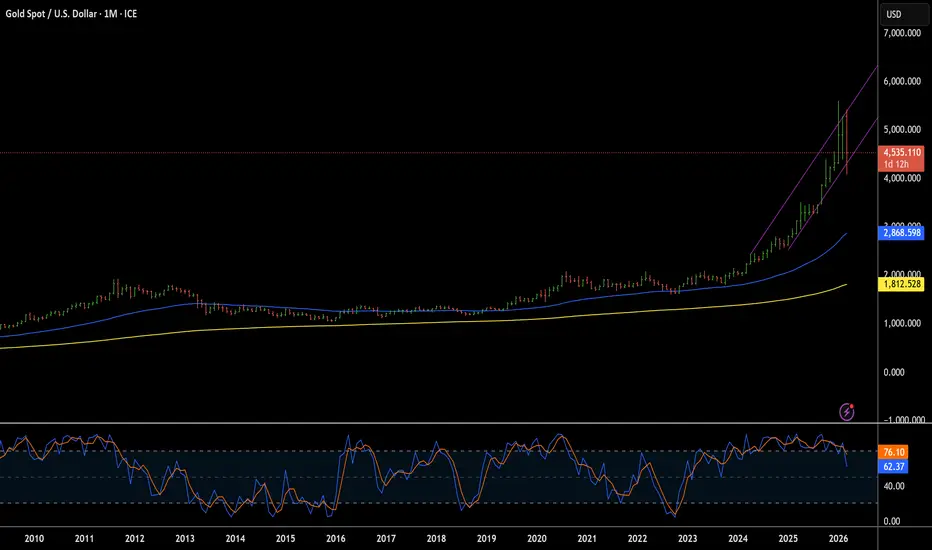
Gold’s Path to $5,000: Strategic Drivers in 2026Gold currently tests a critical $4,350 support level. Traders now eye a historic surge toward the $5,000 milestone. This rally stems from more than simple market fear. It reflects a fundamental shift in the global financial architecture. Investors must analyze the multifaceted forces driving this unprecedented price action.
Geostrategy and the De-Dollarization Trend
Central banks continue to hoard bullion at record paces. Emerging economies seek to reduce reliance on Western financial systems. This de-dollarization strategy creates a permanent floor for gold prices. Gold remains the only neutral reserve asset in a fragmented world. Strategic reserves now prioritize physical metal over digital fiat counterparts.
Macroeconomic Pressures and Currency Debasement
Persistent fiscal deficits in major economies drive significant currency debasement. Real interest rates remain volatile, pushing investors toward tangible assets. Gold acts as a primary barometer for global monetary instability. If the $4,350 floor holds, the momentum toward $5,000 appears inevitable. Macroeconomic indicators suggest a long-term bullish cycle for precious metals.
High-Tech Innovation and Patent Analysis
High-tech demand for gold is accelerating rapidly. Quantum computing and advanced medical sensors require gold’s unique conductivity. Patent analysis shows a 15% rise in gold-based nanotechnology applications. These innovations transform gold into an essential industrial component. Science proves that gold is a critical high-tech metal, not just jewelry.
Mining Industry Trends and ESG Leadership
Mining companies face rising extraction costs and stricter ESG mandates. Management teams now prioritize high-margin "Tier 1" assets. Innovation in "green mining" allows firms to access previously unreachable deposits. Successful leadership focuses on sustainable yield rather than raw volume. These industry shifts limit supply while global demand continues to climb.
Cybersecurity and the Digital Hedge
Digital assets face increasing risks from quantum decryption threats. Gold offers a physical, unhackable alternative for wealth preservation. Sovereign states recognize gold as the ultimate insurance against systemic digital collapse. It provides absolute security in an era of constant cyber warfare. No algorithm can replicate the physical permanence of gold.
Business Models and the New Gold Standard
Modern business models now integrate gold-backed digital tokens. These "stablecoins" bridge the gap between physical reliability and digital efficiency. This innovation expands the investor base to a tech-savvy generation. Companies using these models provide deep liquidity for the underlying metal. This evolution strengthens the case for gold as a modern financial cornerstone.
Trend (1H – SOL/USD)📉 Trend (1H – SOL/USD)
Clear downtrend
Lower highs + lower lows
Price below:
falling trendline (dashed)
average (red – acts as dynamic resistance)
➡️ Until this changes = bias short
📊 Key levels
🔴 Support:
81.3 – currently tested (very important)
79.7 – next level (if 81 breaks → quick move)
76.9 – deep target
🟢 Resistance:
84.2 – first local resistance
86.2
87.6 + MA – key trend reversal area
📉 Price Action
Consolidation at low range (81–83)
No strong rebound → weakness
Every bounce = weaker (classic bear continuation)
➡️ Looks like a bear flag / distribution before the next pullback
📊 Indicators
🔵 Stoch RSI
Rebound from oversold market
But... no price reaction → bearish divergence vibe
🔴 MACD
Still below zero
Weak downward momentum, but not reversed
➡️ This is more of a consolidation before a move, not a reversal
🎯 Scenarios
🟥 Bearish (more likely)
Break 81.3
Target:
79.7
77
➡️ If a breakout with volume → a quick dump
🟩 Bullish (contrarian)
Conditions:
reclaim 83.5–84
break above the trendline
Target:
86 → 87.5
➡️ but this is less likely for now
🧠 Conclusion (most important)
Trend = down
Structure = bearish continuation
Price = at support → decision point
👉 Best setup:
short on a breakout of 81.3
OR
short on a retest of 83–84 (if it raises)
AUD/USD Daily AnalysisPrice had been bouncing off the 0.6980 level for over 2 weeks in March before finally closing below last week.
Is this a change of direction now?
A retest and rejection may provide a sell set up but if the level doesn't hold then look for price to push back above and look for a buy set up.
Whatever your thoughts, look for a trade that meets your strategy rules.
Oil prices will explode because of this event|Economic recessinOil prices will explode because of this event | Economic recession
Don’t forget: 100% of economic recessions have started with rising oil prices.
If Iran manages to control the Strait of Hormuz, and at the same time the Bab el-Mandeb Strait is closed by the Houthis in Yemen, or if a major attack on Saudi Aramco occurs,
oil prices will skyrocket.
Not financial advice – Amir Ghasemi
DXY | FRGNT DAILY OUTLOOK | CONTINUED LONGS UNTIL CONFIRMED 📅 Q1 | W14 | D30 | Y26 |
📊DXY | FRGNT DAILY OUTLOOK | CONTINUED LONGS UNTIL CONFIRMED STRUCTURAL BREAKS
🔍 Analysis Framework
This forecast is built using an advanced adaptation of Smart Money Concepts, with a structured and disciplined approach:
• Marking Key Points of Interest (POIs) on Higher Time Frames (HTFs) 🕰️
• Defining a clear, controlled trading range from those zones 📐
• Refining entries on Lower Time Frames (LTFs) 🔎
• Waiting for confirmed Break of Structure (BoS) before execution ✅
This process ensures precision, removes emotional decision-making, and keeps me aligned with the overall market narrative.
💡 Core Philosophy
“Capital management, discipline, and consistency create longevity.”
A strong risk-to-reward model, paired with high-probability execution, is the foundation of sustainable trading 📈🔐
⚠️ Understanding Losses
"Losses are part of the game" — a mathematical certainty 🎲
They don’t define performance. Nor do they define you as a Trader.
They are managed, reviewed, and used as evidence for growth 📊
🙏 Final Note
Appreciate you taking the time to review today’s forecast.
Stay disciplined 🎯
Protect your capital 🔐
— FRGNT 🚀📈
📌 Disclaimer
This content is for educational purposes only and does not constitute financial advice.
It reflects my personal approach to the markets — a tested framework that has supported my own journey to consistent profitability in trading currencies.
This is not a signal service, and all trading decisions remain your own responsibility.
Additionally, this post is not intended to breach ANY TradingView House Rules.
TVC:DXY